



The Universal Blueprint: Why Romantic Dramas Share the Same Core Story Structure
Exploring genre's influence on story structure.
Many writers often wonder if genre should dictate their story structure. This question becomes particularly relevant when considering tools like Subtxt. A potential user, who specializes in steamy romance, recently queried whether Subtxt could support outlining structures like "Romancing the Beat". In this discussion, we'll delve into this question, exploring the relationship between genre, story structure, and the use of narrative tools.
Hello! I have a question. I'm considering subscribing to Subtxt to help me with plotting my novels/stories. Is Subtxt heavily censored? I'm a steamy romance writer and currently use ChatGPT and Claude 2 for plotting/outlining. But it's a bit difficult with the heavy censorship on creativity and it's not tailored specifically for fiction writers. It would be nice to have a tool that can really help me organize and go deep with my books...But before I invest on another tool, I want to first see if this would be helpful for steamy romance writers. Are other outlining structures like Romancing the Beat available with this tool? Or other outlining structures specifically crafted for Romance?
First off, let me say that this is a fantastic question! It's always great to see writers exploring new tools and methods to enhance their storytelling. So, let's dive right in.
Narrative Structure is Not Genre-Dependent
The first thing to understand is that narrative structure is not dependent upon genre Whether you're writing a psychological thriller, a slasher film, or a steamy romance, the underlying structure of your story remains the same. This isn't to say there is "one template to rule them all", but rather that the way in which the elements of a narrative are tied together is similar regardless of genre. In Subtxt, Genre reflects the narrative personality of a work, setting the type of conflict and the areas to be explored within your story.
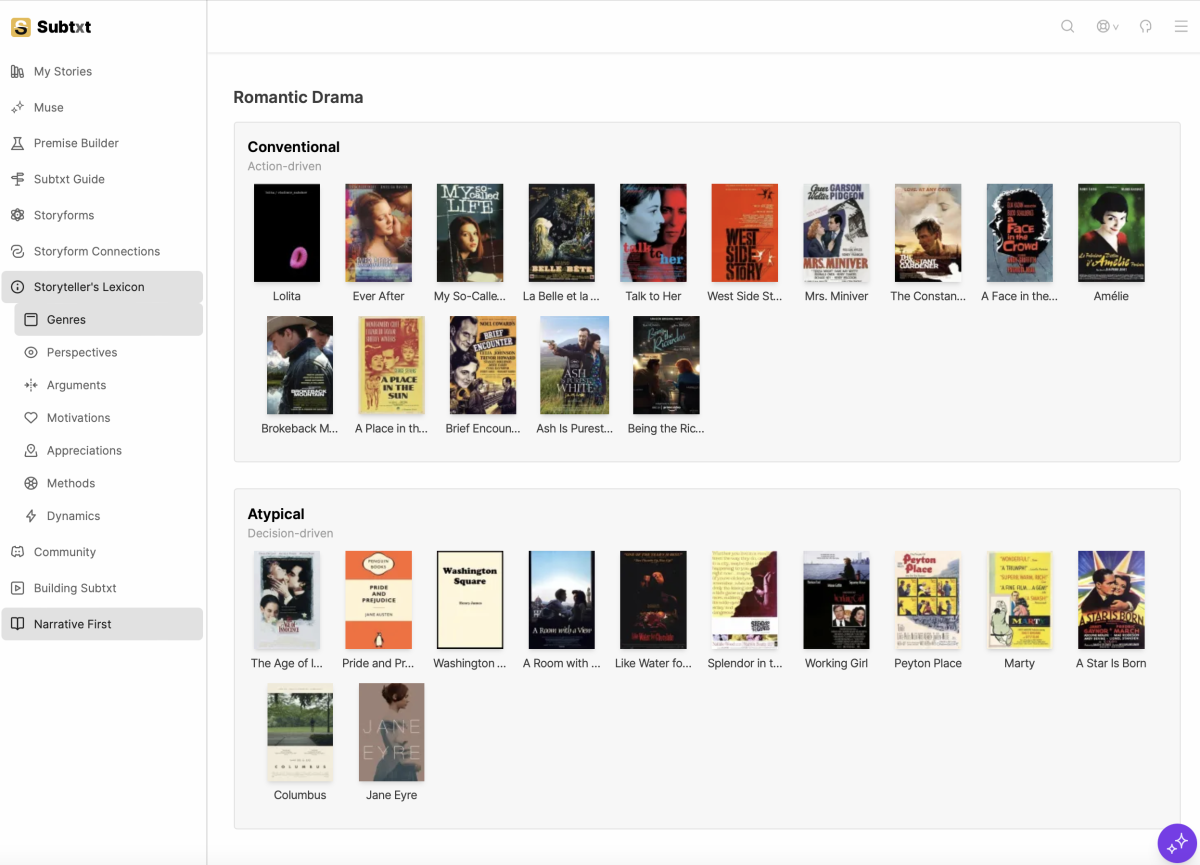
For example, a Romance or Romantic Drama typically focuses on psychological conflict, dealing with the conflicting psychologies or neuroses of the characters. The central romance, on the other hand, is usually physical in nature. The balance between these two (psychological and physical) is essential because of the way our minds resolve conflict.
More on that later.
Moderating Generative AI
Regarding censorship, and the generative technologies behind large-language models (LLMs), there are certain rules that the providers of these systems require us to follow in our applications. Subtxt does have these moderation filters, but they are usually triggered by abusive language or scenarios that are not suitable for the platform. That said, it's important to understand that Subtxt distinguishes between the subtext of a work and the storytelling of that work.
Think of it like this: Romeo and Juliet and West Side Story have the same underlying narrative structure (subtext), but the storytelling is completely different. Subtxt is designed to help with the former, not the latter. So, even if you're writing a steamy romance, what's really at play in terms of conflict isn't what you're getting flagged for--you're getting flagged for the "steamy" storytelling, not the source of conflict between the two principal characters.
In short, you would use Subtxt to work out how the story proceeds, and then use anything BUT a large-language model to actually write the final story.
Diving into "Romancing the Beat"
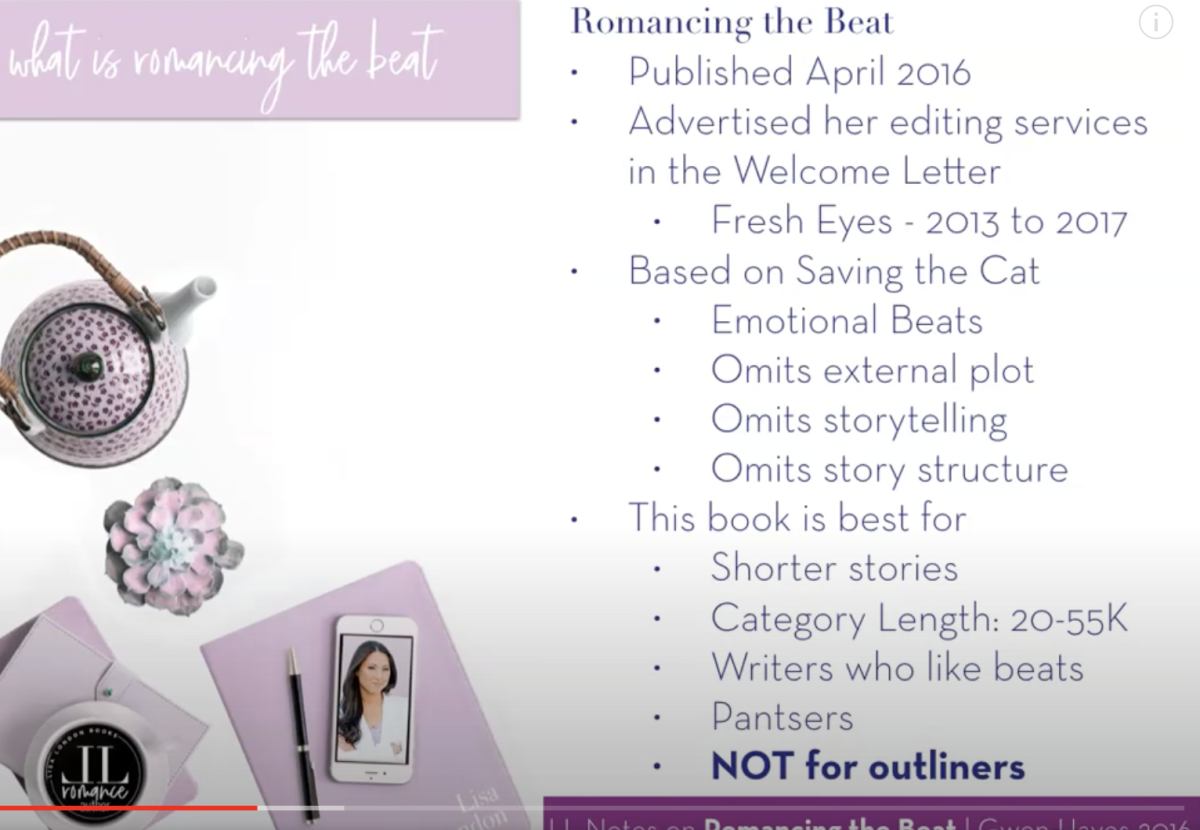
Now, let's talk about "Romancing the Beat". Prior to this question, I wasn't familiar with this outlining structure. After looking into it (and finding this review on YouTube), it seems to emphasize what we refer to as the Relationship Story Throughline over the Objective Story Throughline.
In Subtxt/Dramatica theory of narrative, there are Four Throughlines in a Complete Story:
- the Objective Story (external plot)
- the Main Character (personal baggage of the central character)
- the Obstacle Character (challenge towards the MC's personal justifications)
- and the Relationship Story (the growth of the central relationship over time)
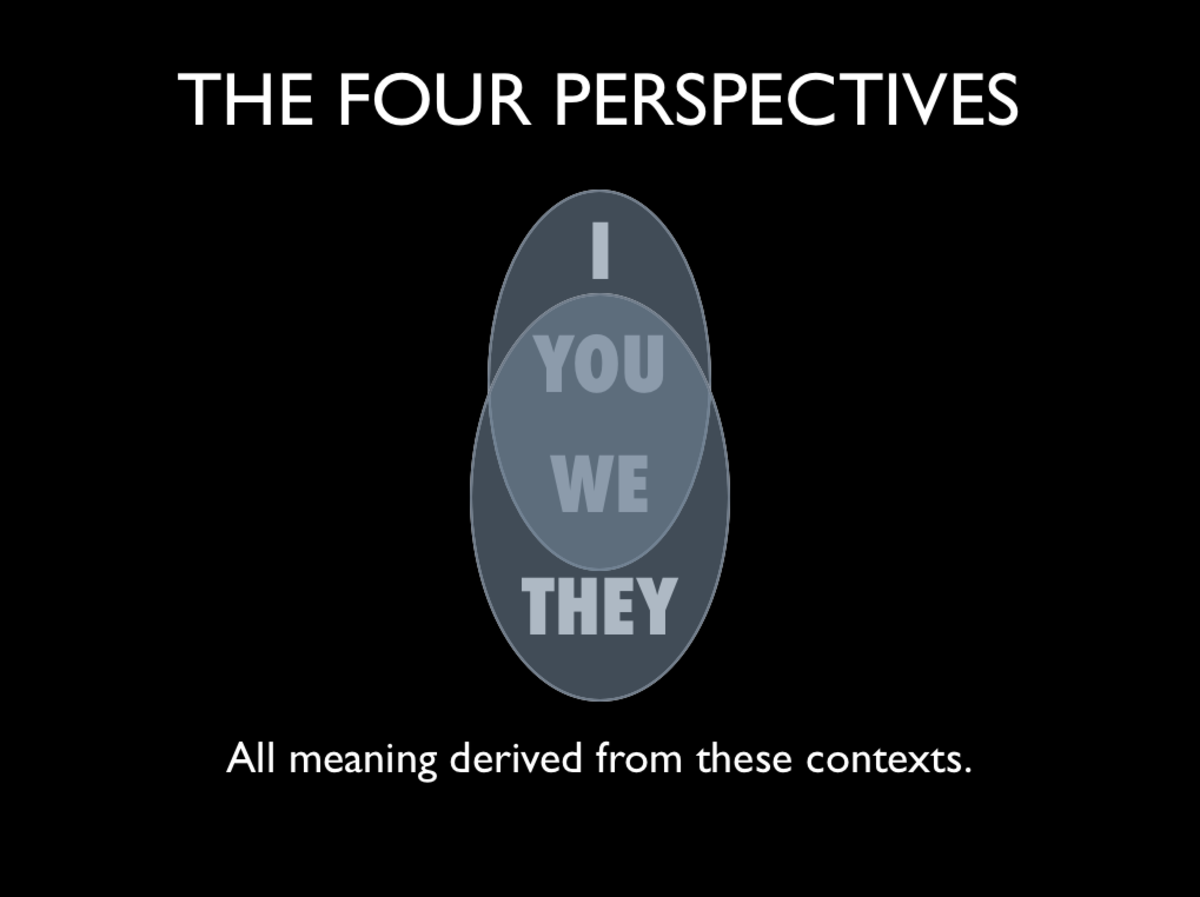
The Relationship Story is not about the Main Character or the Obstacle Character, but about the growth of the relationship over the course of the narrative. It's important to have both the Relationship Story as well as the more personal Main Character and Obstacle Character Throughlines, as we experience conflict from these four points-of-view all the time and every day:
- I have a conflict (Main Character)
- You have a conflict (Obstacle Character)
- We have conflict (Relationship Story)
- They have conflict (Objective Story)
This reality of our minds is why it's important to include the "external" plot in every kind of narrative--even a Romance. The growth of a relationship means nothing without the logistical concerns of how others interact with one another to measure that growth against. In other words, up means nothing without down, love without hate, etc. You need the balance between the two to make sense (and emotional sense) of what you are experiencing when it comes to conflict.
Adjusting the Impact of Various Throughlines
That said, Subtxt does give you access to "dials" for each of these Throughlines, allowing you to increase or decrease the amount of attention to each. Given what I see in "Romancing the Beat", it looks like the settings would likely be 75% Relationship Story, 15% Main Character, and 10% Obstacle Character, with nothing given to the Objective Story.
This is totally fine (you are free, after all, to write whatever you want), but just know that you effectively decreasing the reachability of your work. There are many in your potential Audience who will not have the patience to sit still or work their way through a narrative that leaves out this all-important aspect of our lives.
Writing Shorter Versions of Complete Stories
The potential absence of an Objective Story Throughline is where the adaptation of Twilight from novel to film becomes a fascinating case study. The original novel, from what I've gathered second-hand, was likely composed of 65% Main Character (MC) Throughline, 30% Relationship Story (RS) Throughline, and a mere 5% Objective Character (OC) Throughline. The film, however, introduced or emphasized an external plot--the conflict between wolves and vampires--to bolster the Objective Story (OS) Throughline. This addition provided a broader context for the more subjective elements of the narrative.
Subtxt, the tool I developed, is designed to guide you in crafting a complete story, encouraging the inclusion of all Four Throughlines. However, it's not a rigid system. You could generate a Storyform (a narrative structure) and focus solely on the Relationship Story Throughline it suggests and still be guided along the way to write something that "feels" complete. This approach would be similar to writing a short story, which typically presents a "slice" of a complete narrative (most often, one Throughline to the exclusion of others).
"Romancing the Beat," for instance, seems to work better with shorter stories, particularly those under 50k words. This is likely because it concentrates on one or two of the Four Throughlines, rather than all four.
To illustrate this point with a contemporary example, consider the film Past Lives from A24. This film is predominantly a Main Character Throughline narrative, with a touch of Relationship Story Throughline and a hint of Obstacle Character Throughline. While it's a critically acclaimed film and a beautiful experience, it falls short of presenting a complete story. The film is wonderful--but it's highly unlikely that it will become a classic.
Readers and viewers often revisit complete stories because they offer something unique: the opportunity to simultaneously experience all Four Throughlines. This is something we can't do in real life, where we can't be both within and outside ourselves at the same time. That's why we're drawn to complete stories--they offer a perspective we can't access in our everyday lives.
Telling the Whole Story
In conclusion, Subtxt is a powerful tool for any genre, including steamy romance. It helps you understand the underlying structure of your story, allowing you to focus on the storytelling. And while it does have moderation filters, these are usually triggered by abusive language or scenarios, not the steamy romance itself.
So, for all the romance writers out there seeking a tool to delve deeper and organize your narratives more effectively, consider giving Subtxt a try. Should you encounter any challenges, don't hesitate to reach out. There's always help along the way to ensure you get the most out of your storytelling journey.
Happy writing! ❤️

Download the FREE e-book Never Trust a Hero
Don't miss out on the latest in narrative theory and storytelling with artificial intelligence. Subscribe to the Narrative First newsletter below and receive a link to download the 20-page e-book, Never Trust a Hero.